
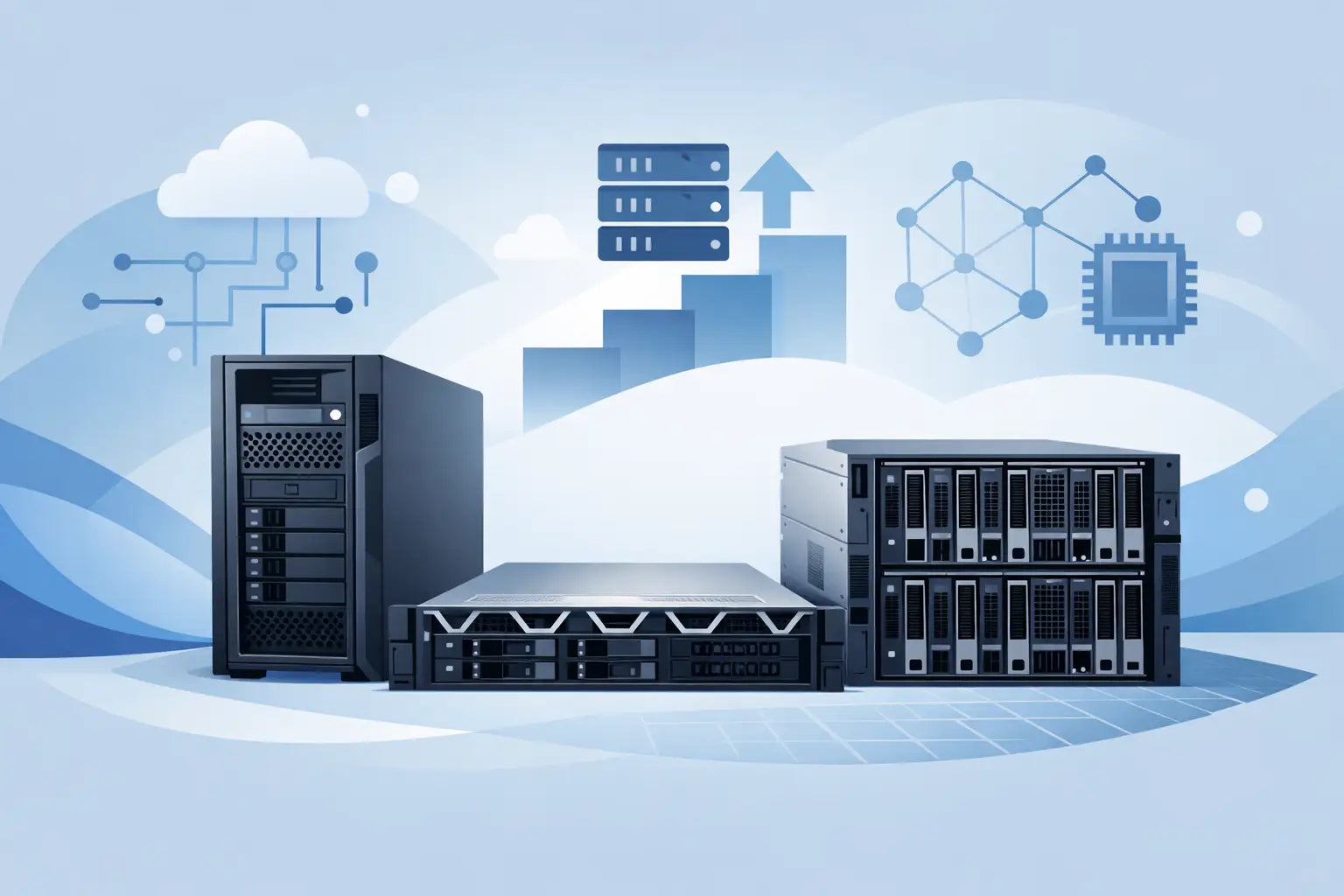
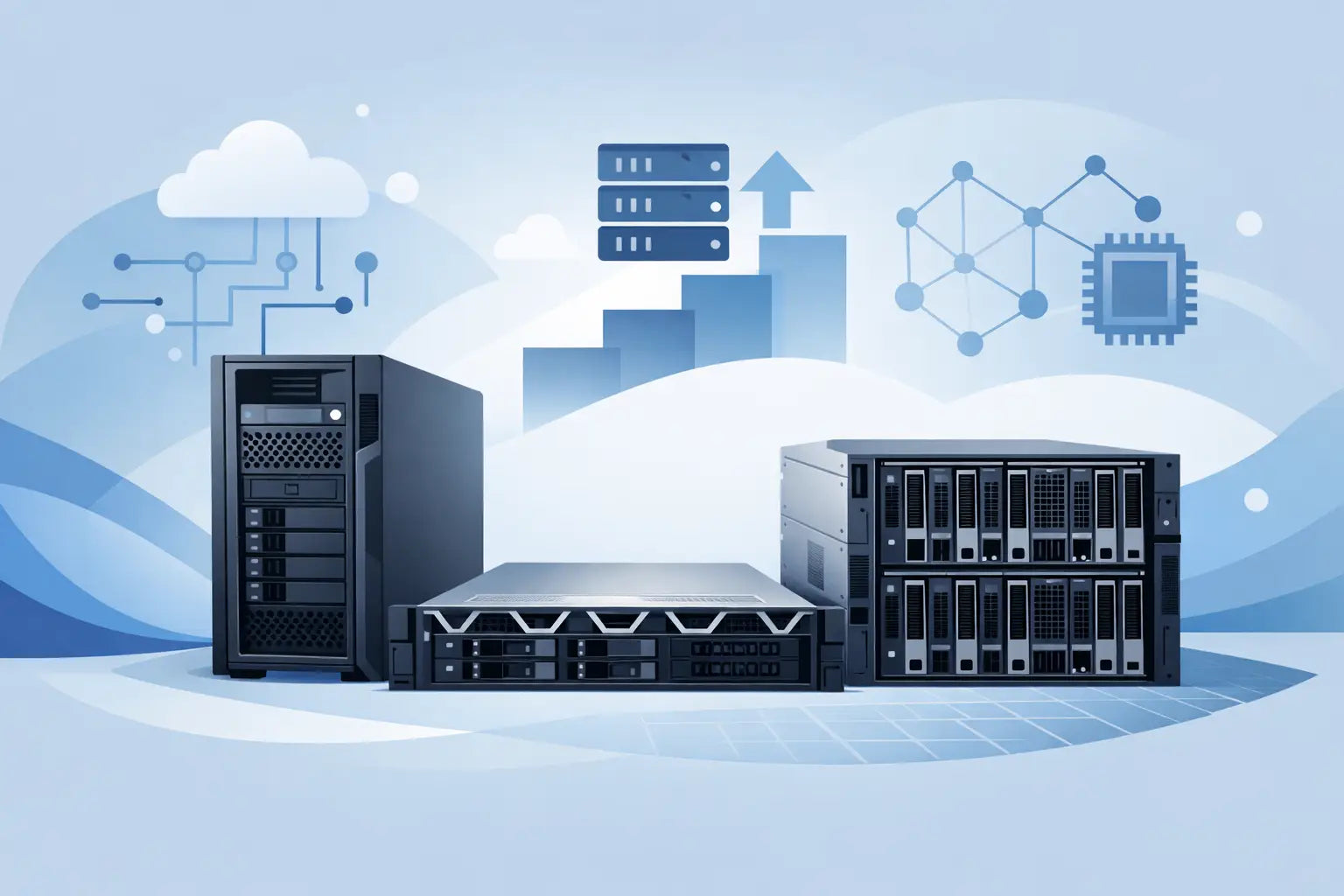
When you are pricing a refresh, extending an existing estate, or sourcing parts for a failed node, a Dell PowerEdge generation guide is usually more useful than another generic server overview. The practical question is not what Dell servers are in theory. It is which generation fits your workload, your rack, your budget and your upgrade path without creating avoidable compatibility issues.
For most buyers in the refurbished market, the real comparison starts with Dell Gen12, Gen13 and Gen14. Those three generations cover a large share of still-deployed PowerEdge infrastructure across SMEs, MSP estates, virtualisation hosts, backup targets and branch office deployments. They also represent three distinct points in the balance between acquisition cost, performance per core, memory support, storage options and remaining service life.
Dell PowerEdge generation guide by platform era
Dell PowerEdge generations are commonly grouped by platform family rather than just release date. In procurement terms, that matters because generation usually maps directly to processor support, memory type, storage controller options and firmware baseline.
Gen12 systems are built around Intel Xeon E5-2600 and E5-2400 product families in their v1 and v2 forms, depending on model and revision. In practical terms, these systems are now firmly established as low-cost infrastructure for secondary workloads, test environments, archive storage, edge deployments and legacy application support. Typical models include the PowerEdge R620, R720, R720xd, R820 and T620.
Gen13 moved the platform onto Intel Xeon E5-2600 v3 and v4, with DDR4 memory and broader improvements in efficiency, virtualisation density and storage flexibility. This generation remains highly relevant for buyers who need solid core counts, sensible RAM ceilings and good parts availability without moving to current OEM pricing. Common models include the R430, R530, R630, R730, R730xd and T630.
Gen14 introduced Intel Xeon Scalable processors, with a more substantial architecture shift. For buyers running heavier virtualisation estates, software-defined storage, denser database workloads or more demanding line-of-business applications, Gen14 generally marks the point where platform capability starts to feel modern rather than merely serviceable. Frequently sourced models include the R440, R540, R640, R740 and R740xd.
What changes from Gen12 to Gen14
The biggest practical shift across the Dell PowerEdge generation guide is not branding. It is the platform stack underneath the chassis.
Gen12 is DDR3. Gen13 moves to DDR4. Gen14 stays on DDR4 but pairs it with Xeon Scalable CPUs, improved PCIe capability and a more current storage and management baseline. If you are standardising parts across multiple nodes, that alone can make mixed-generation estates harder to manage than they first appear.
Processor progression is equally important. Gen12 still has value where licence costs, modest concurrency or non-critical workloads make low acquisition cost the priority. But once you need stronger per-core performance, better power efficiency and more headroom for consolidation, Gen13 is often the minimum sensible target. Gen14 then becomes the stronger option where workload growth, longer deployment windows or higher VM density justify the extra spend.
Storage is another dividing line. All three generations can support a wide range of SAS, SATA and SSD configurations depending on controller and backplane, but the practical experience improves as you move forward. Higher performance RAID options, better SSD suitability and broader support for newer media make Gen13 and especially Gen14 easier to position for mixed-use environments.
When Dell Gen12 still makes sense
Gen12 is no longer the default recommendation for primary production estates, but that does not make it redundant. It makes it selective.
If you need an inexpensive host for backup repositories, domain services, monitoring, development, low-intensity file services or a spare unit to hold in reserve, Gen12 can still be commercially sensible. It is also useful where an existing estate is already standardised on DDR3 memory, older PERC controllers and E5 v1 or v2 processors, and you want to extend platform life rather than introduce a new hardware tier.
The trade-off is obvious. You gain a low entry price and broad availability in the refurbished market, but you accept older architecture, higher power draw relative to performance, and a shorter realistic runway for future expansion. Buyers using Gen12 today are usually doing so because they know exactly what the workload requires and have no interest in paying for unused headroom.
Where Dell Gen13 remains the volume buy
For many business buyers, Gen13 is still the most balanced point in the market. It is newer enough to support serious production use, but mature enough that pricing on complete systems and components is usually far more attractive than Gen14.
That balance shows up clearly in rack deployments. An R630 or R730 can still serve well as a virtualisation host, application server, backup platform or general compute node, particularly where dual-socket E5-2600 v3 or v4 CPUs and larger DDR4 configurations are sufficient. The range also gives buyers flexibility between compact 1U density and 2U storage or expansion-heavy builds.
This is often the right answer for estates that need reliable enterprise hardware at controlled cost. If the requirement is to add capacity, replace failed hardware like-for-like, or maintain consistency with an installed Gen13 estate, the commercial logic is straightforward. You get a current-enough platform with established parts supply and familiar management characteristics.
Why Gen14 changes the buying case
Gen14 is where many buyers stop thinking purely in terms of replacement and start thinking in terms of platform progression. Xeon Scalable support, stronger memory architecture and better overall performance per system make these servers easier to justify for workloads that would strain older platforms or require too many older nodes to handle efficiently.
That does not mean Gen14 is always the cheapest route. It rarely is on initial purchase. But where rack space, power, consolidation ratios or software licensing matter, paying more for fewer, stronger systems can be the better calculation. A smaller number of Gen14 nodes may replace a larger footprint of Gen12 or Gen13 servers while simplifying support and reducing overhead in the process.
For buyers building a refreshed production estate with a longer expected service window, Gen14 is often the more practical starting point. It also tends to make more sense where NVMe, denser memory configurations or heavier mixed workloads are part of the requirement rather than an afterthought.
Chassis choice matters as much as generation
A Dell generation comparison on its own is not enough. The chassis still determines a large part of real-world suitability.
A 1U platform such as an R620, R630 or R640 may be the right fit for compute density, but not if you need extensive local storage, more PCIe expansion or easier service access for certain card configurations. A 2U system such as an R720xd, R730xd or R740xd may cost more and take more rack space, but gives a stronger platform for storage-heavy roles, GPU options in some configurations, or wider expansion needs.
Tower models also remain relevant in branch, office or low-rack-density environments. The generation tells you the platform era. The model tells you whether it will actually fit the workload.
Parts, upgrades and compatibility checks
One reason buyers use a Dell PowerEdge generation guide is to avoid ordering the right part for the wrong platform. Across Gen12, Gen13 and Gen14, the most common mistakes involve memory type, CPU family, drive carrier format, RAID controller compatibility and power supply matching.
DDR3 and DDR4 are the obvious split between Gen12 and later platforms, but the details go further than that. Processor support is tied not just to socket class but to system board generation and BIOS level. Storage compatibility can depend on whether the chassis is configured for LFF or SFF drives, what backplane is installed, and which PERC controller is in use. Even where a part appears similar across multiple systems, it should not be treated as interchangeable without checking the exact server model and installed configuration.
This is where refurbished procurement works best when it is specification-led rather than assumption-led. Buyers who match by service tag, Dell part number, system model and intended workload generally avoid the costly mistakes.
Which generation should you buy?
If cost is the main driver and the workload is light or non-critical, Gen12 can still do a job. If you need the broadest balance of price, capability and parts availability, Gen13 is often the strongest value. If you are consolidating, planning for a longer deployment cycle or pushing newer workload demands, Gen14 is usually the better platform.
There is no universal best generation. A backup server, Hyper-V host, Veeam repository and SQL box do not justify the same answer. The right decision comes from matching workload intensity, budget, power envelope, storage layout and component standardisation.
For buyers managing real estates rather than brochure comparisons, that is the useful way to read the market. Buy the newest platform you can justify, but not newer than the workload needs. If you keep that discipline, refurbished PowerEdge hardware remains one of the most commercially sensible ways to build or extend dependable infrastructure.