
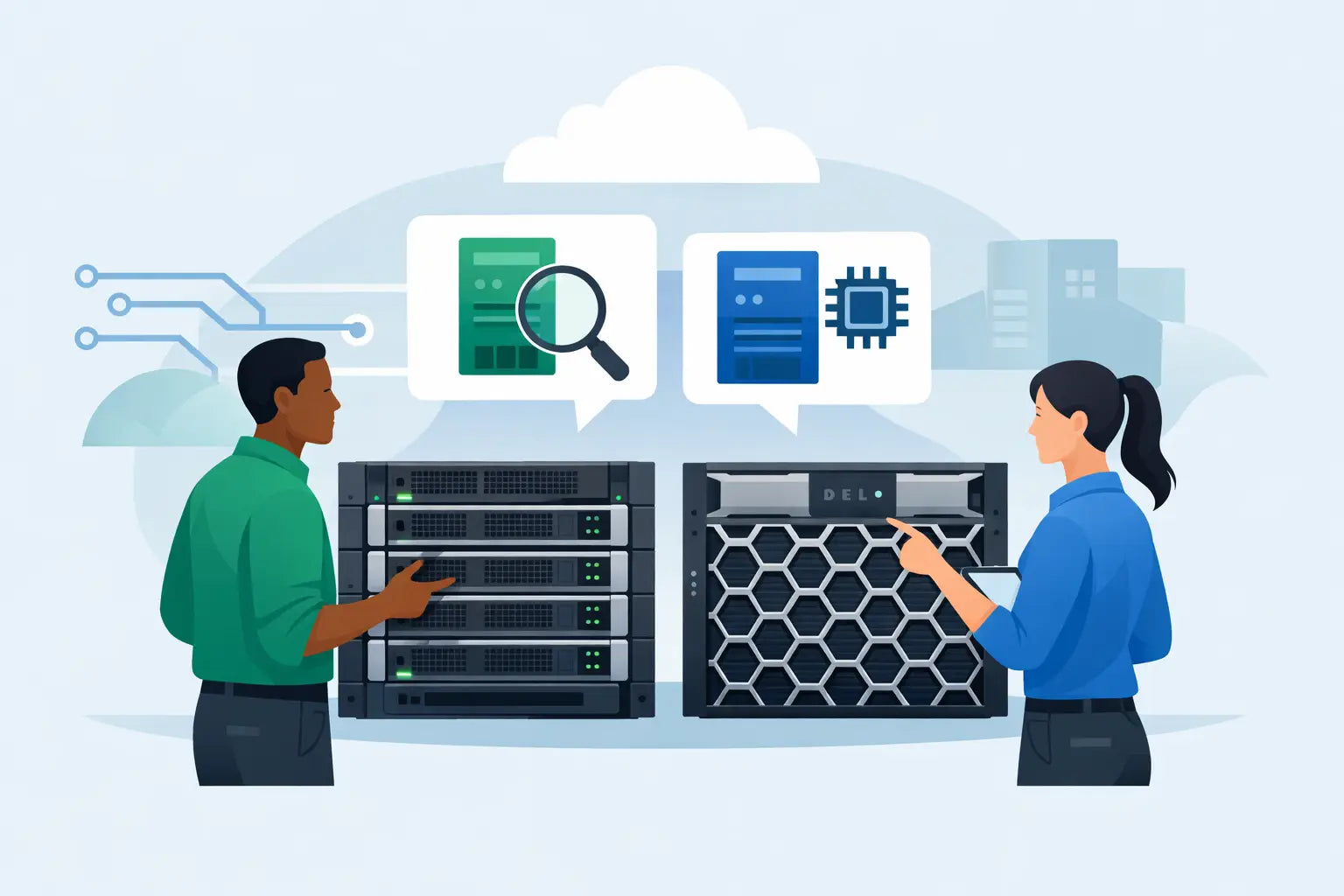
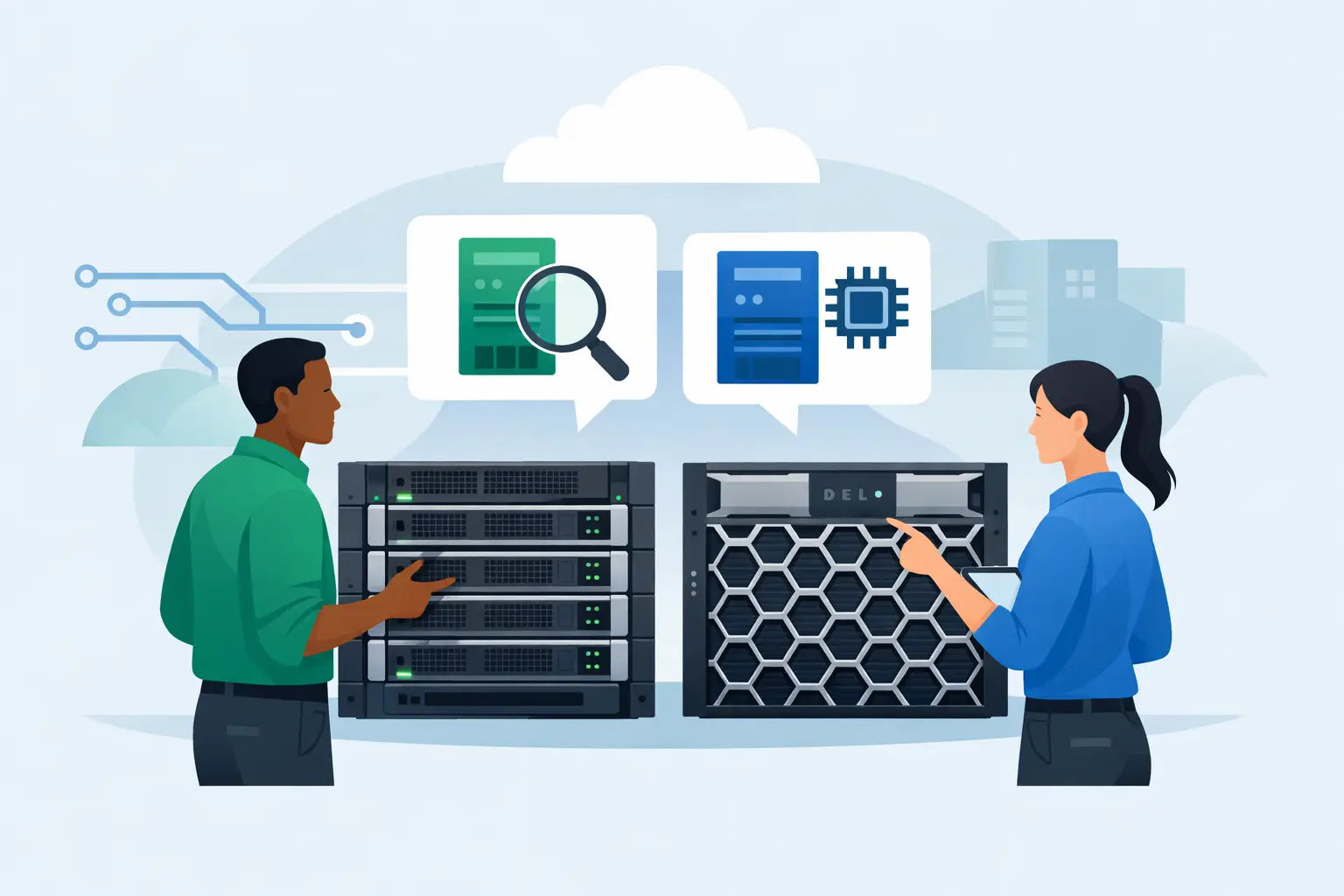
A failed DIMM, an urgent RAID controller replacement or a planned CPU upgrade can quickly expose a basic gap in an asset register: the server is recorded as a “DL380” or “PowerEdge”, but its generation is missing. Knowing how to identify server generation is essential before ordering parts. The same chassis family can span several generations, each with different processors, memory, storage backplanes, firmware requirements and expansion options.
For HPE and Dell estates, the model number is usually the fastest starting point. It is not always the complete answer. A reliable identification process combines the model, physical labels, management interface data and the installed component set. That avoids ordering a part that looks correct but will not fit, initialise or be supported by the platform.
How to identify server generation from the model
For most rack servers, the front bezel, chassis pull-out tag or rear service label gives you a model designation. Start there, then match it to the manufacturer’s generation naming convention.
HPE ProLiant naming is generally straightforward once the series is understood. A DL380 G7 is a seventh-generation ProLiant, while a DL380p Gen8 is an eighth-generation system. From Gen9 onwards, names commonly appear as DL360 Gen9, DL380 Gen9, DL360 Gen10 or DL380 Gen10. The “DL” prefix indicates a rack server; “ML” identifies tower platforms and “BL” identifies blade servers.
There are important variations. The “p” in DL380p Gen8 distinguished the performance model from related variants in that range, while later generations simplified the branding. HPE Gen10 Plus systems also need careful checking. A DL380 Gen10 and DL380 Gen10 Plus are not interchangeable descriptions, even though they belong to the wider Gen10 family. The Plus platform introduced newer processor support and platform changes that affect upgrade compatibility.
Dell PowerEdge generations are commonly identified by the model number. The second digit broadly denotes the generation in many mainstream rack models:
| Dell example | Generation | Typical platform context |
| --- | --- | --- |
| PowerEdge R710 / R720 | 11th / 12th generation | Earlier Intel Xeon E5 platforms |
| PowerEdge R730 / R630 | 13th generation | DDR4-era Xeon E5 v3 and v4 platforms |
| PowerEdge R740 / R640 | 14th generation | Xeon Scalable platform |
In practical purchasing terms, R720 is Dell Gen12, R730 is Dell Gen13 and R740 is Dell Gen14. Do not assume every Dell system follows a simple pattern without verification, particularly with tower, blade, modular and specialised storage platforms. The full model number remains the reference point.
Check the service tag, serial number and product ID
A model label identifies the platform family. The service tag or serial number helps confirm the specific system. Dell servers normally have a seven-character service tag on the pull-out information tag, chassis label and within iDRAC. HPE servers have a serial number and product ID, usually found on the chassis pull-out tag, rear label and in iLO.
These identifiers are particularly useful where a server has been reconfigured. Refurbished enterprise hardware is often supplied with upgraded memory, replacement drives, alternate NICs or different processors. The current component specification may therefore differ from the original factory build. The chassis generation does not change, but relying on an old configuration record can lead to incorrect assumptions about what is installed.
When reading a physical label, record the exact model and any suffixes rather than only the family name. “DL380” alone is not enough. “HPE ProLiant DL380 Gen9” is useful; the product ID, serial number and processor configuration make it more useful still. Likewise, distinguish a Dell PowerEdge R740 from an R740xd. They are both Gen14 servers, but their storage layout and supported drive configuration differ materially.
Asset stickers applied by a previous owner should be treated as supplementary information only. They are helpful for locating a unit in a rack, but they may be out of date after a chassis swap or redeployment.
Use iLO, iDRAC and the operating system for confirmation
If the server is powered on, its management controller is often the cleanest source of identification. HPE iLO displays the server model, serial number, product ID, firmware level and installed hardware inventory. Dell iDRAC provides the system model, service tag, BIOS revision, processor information, memory population and storage controller details.
This method is preferable when the front bezel is missing, labels are worn or the equipment is installed in a crowded rack. It also helps establish whether the hardware configuration matches the information held in procurement records.
At operating-system level, the DMI or SMBIOS data normally exposes the product name and serial number. On Linux, `dmidecode -t system` can return the manufacturer, product name and serial number. On Windows Server, PowerShell can query the system model with `Get-CimInstance Win32_ComputerSystem`. VMware environments can show the hardware platform through the host hardware information or the ESXi command line.
Treat these values as confirmation rather than the only source. A virtual machine reports virtual hardware information, not the generation of the physical host. Run the check on the host operating system, through the hypervisor management interface or via iLO or iDRAC.
Use component clues when the model is unclear
Component generations can narrow down an unknown server, but they should not replace model verification. Memory type is a useful indicator. HPE Gen8 and Dell Gen12 systems typically use DDR3 registered or load-reduced DIMMs. HPE Gen9, Dell Gen13 and Dell Gen14 platforms commonly use DDR4, although processor and platform details determine the exact supported speed and DIMM type.
Processor families provide another strong clue. Intel Xeon E5-2600 v1 and v2 processors point towards older Gen8 or Gen12-era systems. Xeon E5-2600 v3 and v4 are associated with HPE Gen9 and Dell Gen13 platforms. First- and second-generation Intel Xeon Scalable processors are found in many HPE Gen10 and Dell Gen14 configurations.
Storage controller branding can also help. An HPE Smart Array P440ar is commonly seen in Gen9 systems, while Dell PERC H730 and H730P controllers are typical of Gen13. However, controllers can be replaced or added through PCIe, so use them as supporting evidence only.
The following checks are worth making before classifying a system from components alone:
- Confirm the processor model and socket count.
- Identify whether the installed memory is DDR3 or DDR4 and check its registered or load-reduced type.
- Read the model number on the embedded RAID controller or storage backplane.
- Compare the chassis drive layout, including 2.5-inch, 3.5-inch and rear-drive options.
Generation is only the first compatibility check
Once the generation is confirmed, use the exact server model to validate a prospective part. Generation alone does not guarantee fitment. A DL360 Gen9 and DL380 Gen9 share a generation but differ in chassis space, cooling, riser options and storage architecture. The same applies to Dell R630 and R730 systems within Gen13.
For memory, check the server generation, CPU model, DIMM type, speed, rank and population rules. A DDR4 DIMM from a Dell Gen14 server may physically resemble one used in Dell Gen13, but the supported speed and configuration rules can differ. For processors, confirm the socket, processor family, BIOS level, heatsink requirement and whether the server has the correct second CPU riser and fan arrangement.
Storage upgrades require equally careful checking. Establish the backplane type, drive carrier generation, interface - SAS, SATA or NVMe - and RAID or HBA controller capability. An NVMe drive is not automatically usable simply because it fits a 2.5-inch bay. The system needs the correct NVMe backplane, cabling and PCIe connectivity.
Firmware matters as well. A server may technically accept a supported processor or controller but require a BIOS, iLO, iDRAC or RAID firmware update before deployment. Plan this before a maintenance window, particularly where the server supports production workloads.
Build generation data into the asset record
The practical outcome should be a better asset record, not just a one-off identification. Record the manufacturer, exact model, generation, serial number or service tag, CPU configuration, memory type and capacity, storage controller, drive backplane and firmware baseline. This gives procurement and support teams enough information to source replacements without removing the server from service to inspect it again.
For organisations maintaining HPE Gen9, HPE Gen10, Dell Gen12, Dell Gen13 or Dell Gen14 estates, this level of detail also makes lifecycle decisions clearer. It shows which systems can take economical memory or storage upgrades, which need a stocked spare controller or power supply, and which are approaching a point where platform replacement is more sensible than further investment.
Before placing an order, identify the chassis first and the exact configuration second. That small discipline turns “we need a part for a DL380” into a specification that can be supplied accurately, installed confidently and kept in service.