
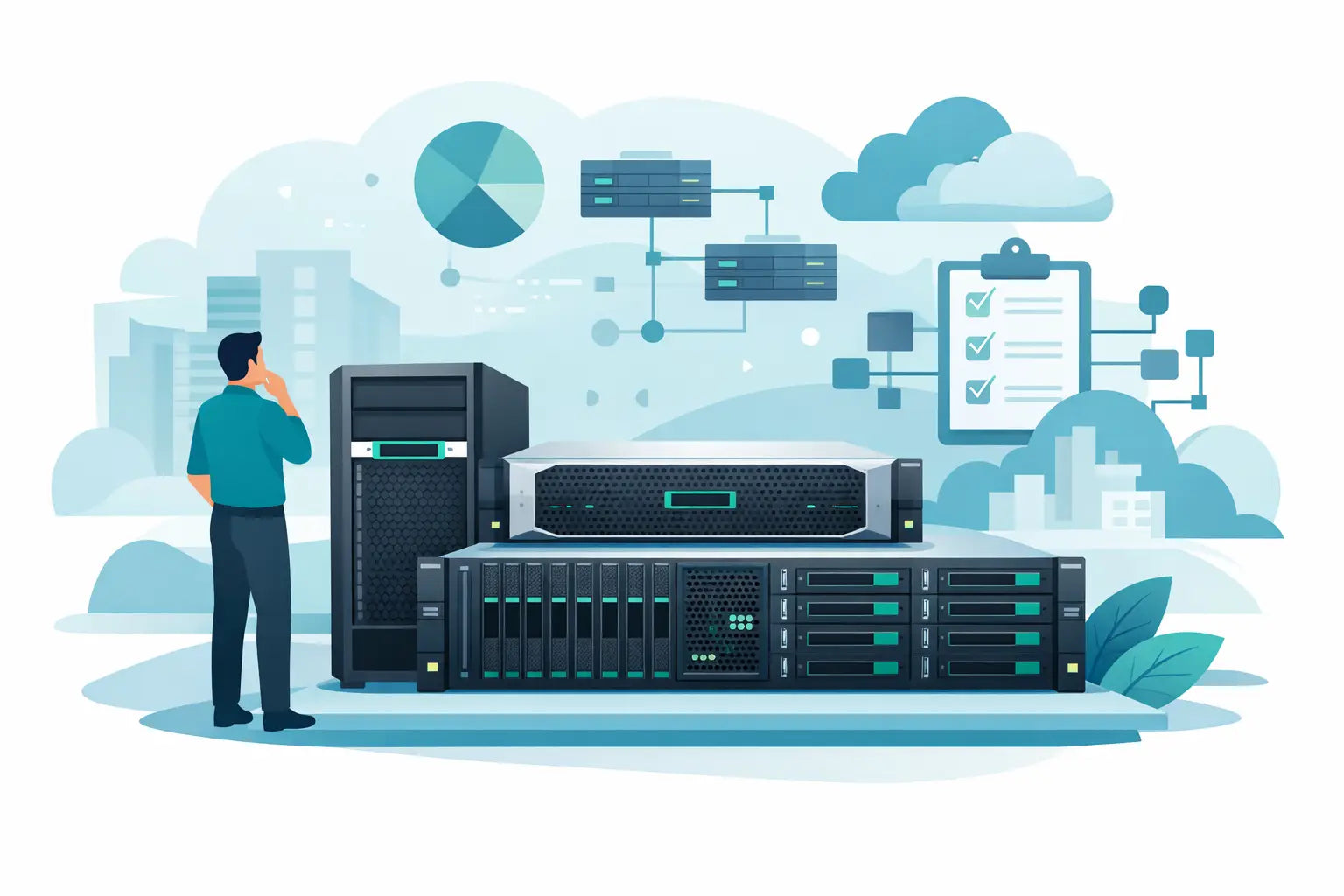
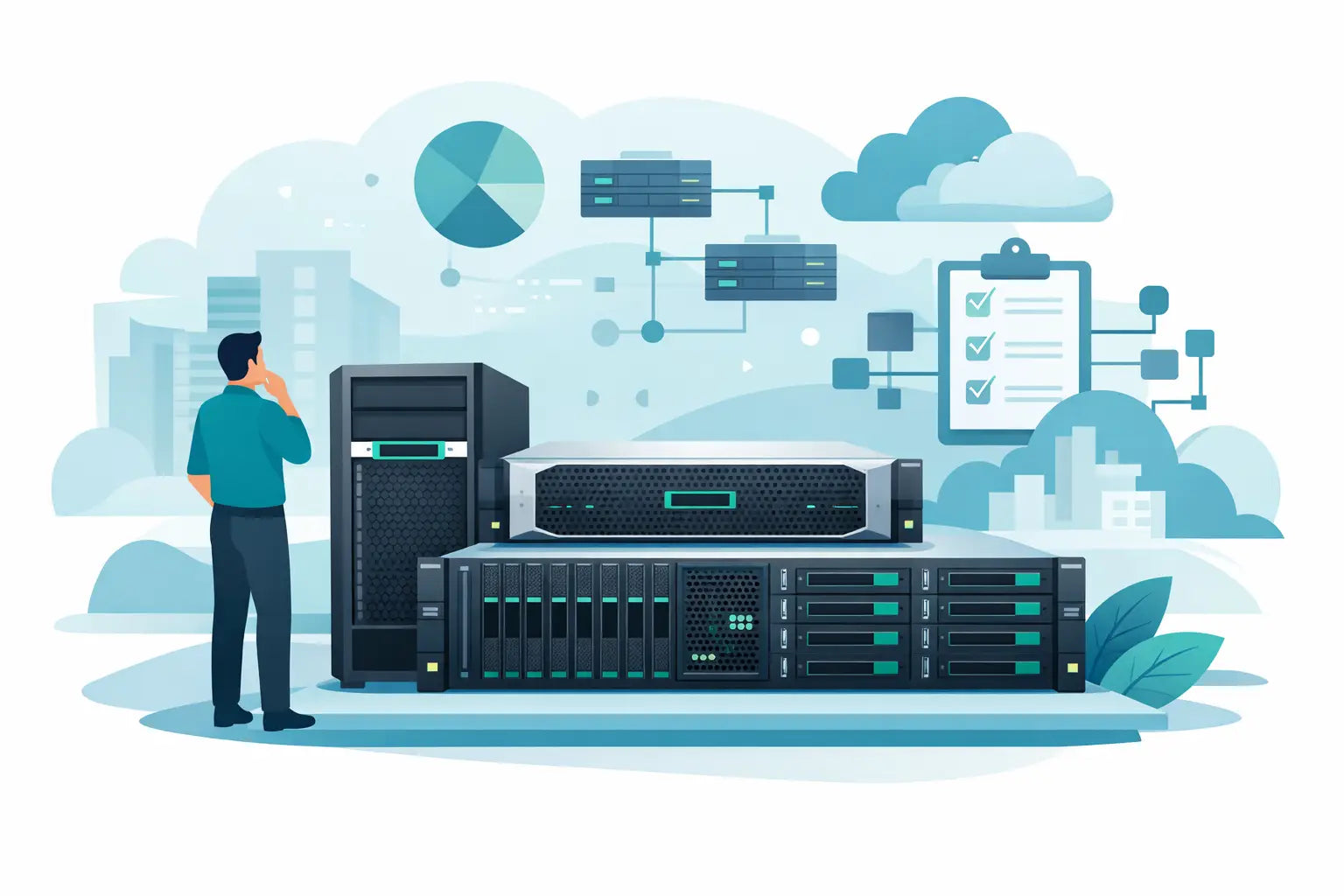
An HPE Gen10 server can be a cost-effective replacement, expansion node or platform refresh, but only if the specification fits the role it will perform. Knowing how to choose HPE Gen10 hardware starts with the workload and the existing estate, not with the processor model or the lowest advertised chassis price.
For most buyers, the decision comes down to four practical questions: how much compute is required, how much local storage is needed, what network connectivity is already in place, and which components must remain compatible with the current environment. A well-specified refurbished Gen10 server can provide years of useful service. An under-specified unit can create an immediate upgrade project.
Start with the right HPE Gen10 platform
The chassis determines expansion capacity, storage layout and physical fit before any component choices are made. HPE ProLiant DL360 Gen10 and DL380 Gen10 are the usual starting points for rack environments, but they serve different requirements.
The DL360 Gen10 is a 1U dual-processor platform suited to high-density compute, virtualisation clusters, application servers and environments where rack space is limited. It provides substantial processing and memory capacity for its size, although drive bays, PCIe expansion and cooling headroom are more constrained than on a 2U system.
The DL380 Gen10 is the more flexible option for many business workloads. Its 2U chassis supports a wider range of drive configurations, more PCIe expansion and generally greater scope for storage controllers, network cards and GPUs. It is commonly selected for virtualisation hosts, database workloads, file services, backup targets and mixed-use infrastructure.
Where a tower form factor is appropriate, the ML350 Gen10 provides expansion capacity without requiring a dedicated rack. It can be a sensible choice for branch offices, smaller sites and businesses replacing an older tower server. It does, however, need suitable cooling, physical security and a realistic plan for local maintenance.
Do not select a server only by model family. Check the exact chassis configuration: small form factor or large form factor drive bays, the number of populated bays, PSU arrangement, riser configuration and installed backplane all affect what can be added later.
Match processor capacity to the workload
Standard HPE Gen10 platforms use Intel Xeon Scalable processors, with support depending on the server model and system board configuration. Refurbished systems may be supplied with Bronze, Silver, Gold or Platinum CPUs, alongside a broad range of core counts and clock speeds.
For infrastructure services with modest CPU demand, such as domain services, monitoring, print services or light application workloads, a Xeon Silver configuration may be sufficient. Higher-frequency CPUs can be preferable for applications that respond more strongly to clock speed than core count. Virtualisation, database workloads and consolidated application servers often benefit from additional cores, provided memory and licensing costs are considered at the same time.
A dual-processor server is not automatically the right purchase. A single CPU can reduce initial cost, power draw and software licensing exposure, but it also limits available memory channels and PCIe lanes. If the server will become a virtualisation host or needs significant storage and network expansion, starting with two matched processors is often more practical.
When comparing processor options, assess total cores, base and turbo frequency, cache, power rating and the intended hypervisor or application licensing model. Per-core licensing can change the commercial case considerably. The cheapest high-core-count CPU is not always the lowest-cost deployment.
Plan memory around population rules, not just capacity
HPE Gen10 servers use DDR4 registered or load-reduced DIMMs, depending on the required capacity and supported configuration. Memory should be selected as a balanced set across the installed processors. Populating one CPU with substantially more memory than the other can restrict performance and leave channels unused.
For a server running a small number of infrastructure virtual machines, 64GB or 128GB may be adequate. A virtualisation host supporting multiple production workloads may need 256GB, 512GB or more. The correct figure depends on actual guest allocation, growth expectations and whether memory-intensive services such as SQL Server, VDI or in-memory caching are planned.
Leave sensible expansion headroom where possible. Buying every DIMM slot at the outset may look efficient, but it makes future upgrades more expensive because existing modules may need replacing. It is usually better to use a balanced population that preserves free slots while maintaining the appropriate memory channel layout.
Check DIMM type, speed and rank before adding memory to an existing server. Mixed capacities and speeds can work in some cases, but the system may operate at the speed of the slowest supported module. For production equipment, matched memory is the cleaner approach.
Specify storage from the data path backwards
Storage decisions should begin with capacity, performance, resilience and recovery requirements. A file server with large archives has different needs from a database server or a VMware host.
Small form factor SAS or SATA SSDs are well suited to high IOPS workloads, virtual machine datastores and operating system volumes. SAS HDDs remain useful where capacity and endurance are required at a controlled cost. Large form factor drives can offer a lower cost per terabyte for backup repositories, archive storage and file shares, but their performance profile is different.
The drive interface and carrier type must match the chassis and backplane. Confirm whether the server has SFF or LFF bays, SAS or SATA connectivity, and whether NVMe support is present. NVMe is not simply a matter of fitting a different drive: it may require the correct backplane, cabling, controller arrangement and PCIe riser.
Select the storage controller according to the RAID level, cache protection and operating system requirements. HPE Smart Array controllers are common across Gen10 deployments, but exact controller models vary. A hardware RAID controller with protected write cache is often appropriate for transactional workloads. For software-defined storage or direct-attached disks presented to an operating system, a different controller mode may be preferable.
Avoid treating RAID as backup. RAID protects availability following a drive failure; it does not protect against deletion, corruption, ransomware or site loss. Storage capacity should be assessed alongside the backup window, retention policy and available network bandwidth.
Check networking, expansion and power before purchase
Many Gen10 servers include embedded network ports, often 1GbE, but this may not suit a virtualisation host, storage server or backup target. Consider whether 10GbE, 25GbE or fibre connectivity is required and ensure the selected NIC matches the switching environment, available transceivers and cabling standard.
PCIe risers are particularly relevant on the DL380 Gen10. A system may have the physical chassis space for additional cards but lack the necessary riser, slot width or available lanes. This matters for additional NICs, Fibre Channel HBAs, SAS expanders, GPU cards and NVMe adapters.
Power supplies should also be reviewed as part of the configuration. Redundant hot-plug PSUs are standard practice for production systems where uptime matters. Check the wattage against the final component load, especially when fitting high-core-count processors, a large drive population or accelerator cards. Confirm that the available power feed and PDU arrangement can support the intended PSU configuration.
Distinguish Gen10 from Gen10 Plus
HPE Gen10 and HPE Gen10 Plus are related but not interchangeable platforms. Gen10 Plus systems generally introduce later Intel Xeon Scalable processor support, PCIe Gen4 capabilities and other platform changes. Components such as processors, memory, risers, backplanes and controllers may differ between the two generations.
When searching for replacement parts or planning an upgrade, use the full server model and generation. “DL380 Gen10” and “DL380 Gen10 Plus” should be treated as separate compatibility checks. The same applies to HPE part numbers, drive carriers, power supplies and controller cache modules.
Review the complete supplied configuration
A refurbished server listing should be read as a supplied specification, not an assumption that every standard feature is included. Verify the processor quantity and exact CPU model, installed RAM, drive bays and drive caddies, storage controller, network interfaces, power supplies, rails and bezel where relevant.
For remote administration, check the installed iLO licensing level and whether the required functionality is included. iLO provides valuable out-of-band management for remote sites and data centre environments, but some capabilities depend on licensing. If the server will operate without regular hands-on access, this is worth confirming before deployment.
Also establish the operating system and hypervisor plan early. Driver availability, firmware baseline, storage controller configuration and secure boot settings should be validated against the intended platform. If the server is joining an existing cluster, align firmware, NIC type and processor generation where the hypervisor vendor’s compatibility guidance requires it.
Buy for the next upgrade, not only today’s requirement
The strongest HPE Gen10 purchase is usually not the highest specification available. It is the configuration that meets the current workload while retaining economical options for memory, storage, networking and CPU expansion.
For example, a DL380 Gen10 with spare drive bays, redundant power supplies and available PCIe capacity may represent better value than a lower-priced chassis that is already fully populated. Equally, a lightly configured DL360 Gen10 may be the right answer where compute density matters more than local storage.
Before placing an order, record the server’s intended role, minimum resource requirement, preferred upgrade path and component compatibility constraints. That short exercise makes it far easier to compare like-for-like configurations and source the right Gen10 platform without paying for capacity that will remain unused.